
Scharf Art
Cosmic Color Comes to Kranzbergville: Kenny Scharf and the New Walls Off Washington
by Craig Kaminer / photography by Zach Dalin
It’s a rare thing when the art world’s cosmic energy focuses squarely on St. Louis. But in early November, that’s exactly what happened when Kenny Scharf — one of the luminaries of New York’s 1980s East Village art explosion and a close contemporary of Keith Haring, Jean-Michel Basquiat and Andy Warhol — touched down in Midtown to paint a new mural for the Kranzberg Arts Foundation.
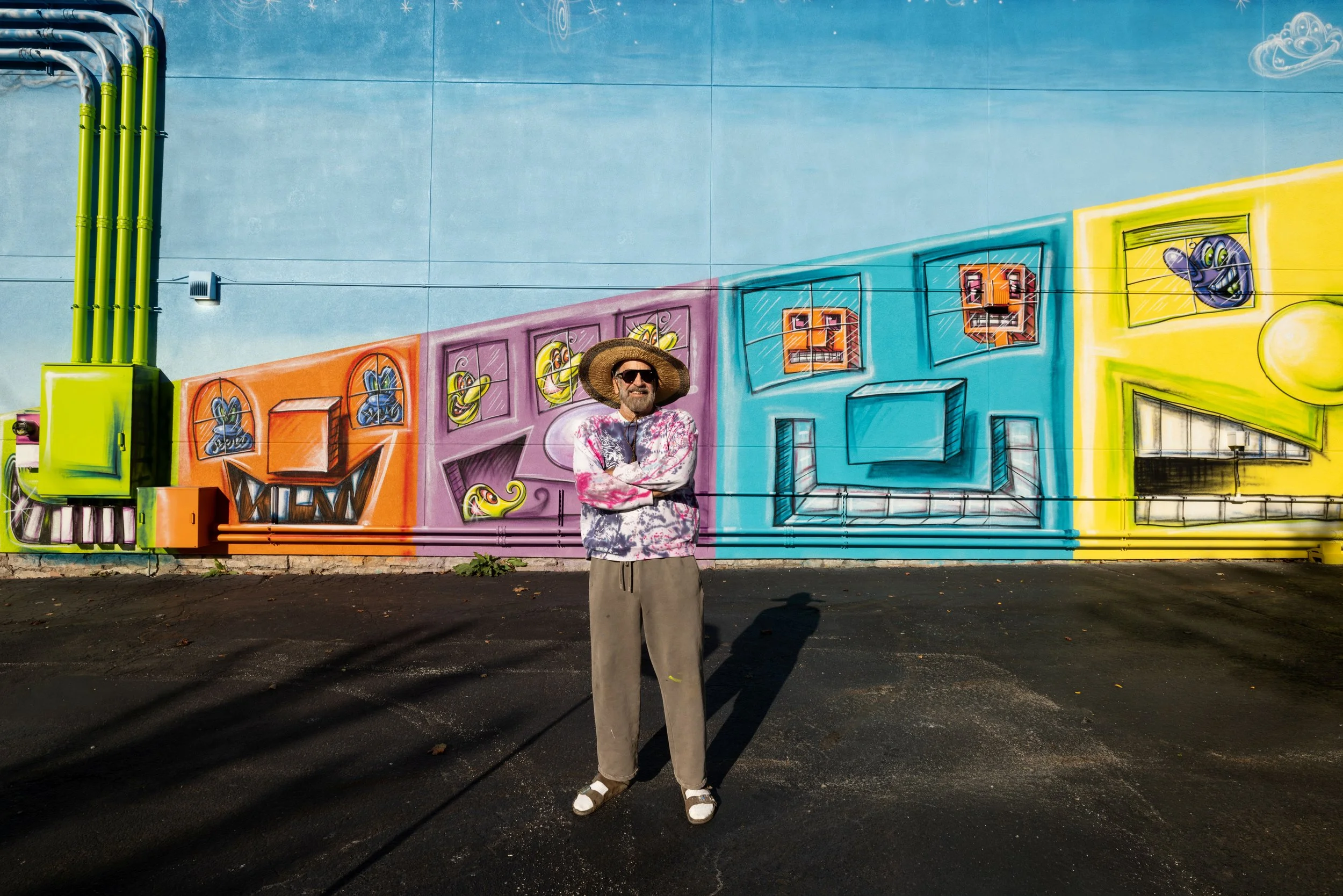
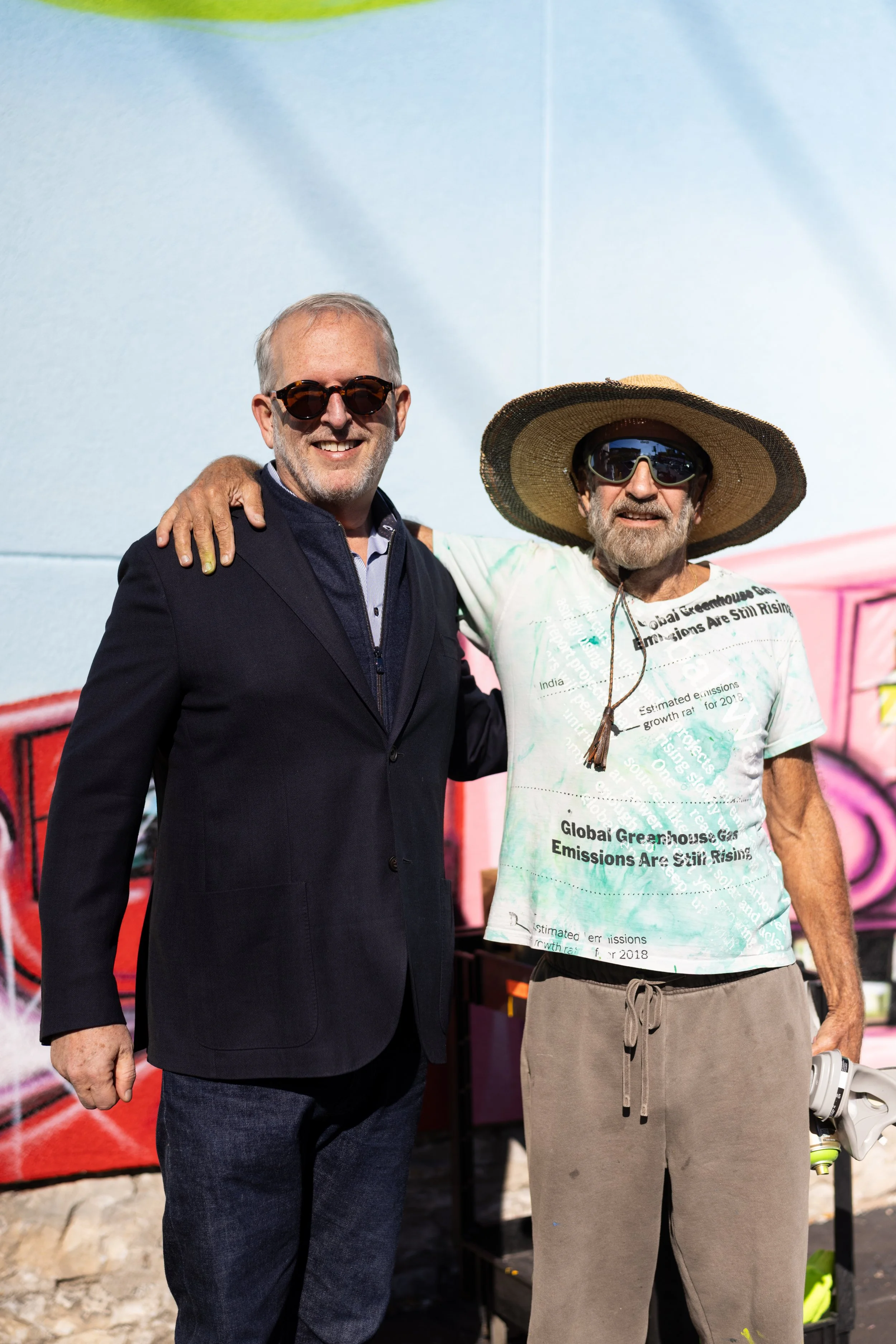
Artist Kenny Scharf
For a few electrifying days, the alleyways behind Washington Avenue were transformed into something resembling a 1980s downtown NYC studio — spray paint cans clattering, colors colliding and curious onlookers drawn into the buzz of creativity. Scharf called the mural “Kranzbergville For EVA” — a title that riffs on the nickname for this growing arts corridor and his own boundless optimism: forever, infinite, ever-expanding.
Watch this and other fascinating videos about St. Louis on Sophisticated TV.
“I have a couple prerequisites for the murals I do,” Scharf says. “They have to be public, highly visible and permanent. I don’t charge for them. I do them because I love doing them. It’s a huge stage and a great opportunity. Honestly, sometimes I feel like I should be paying them to let me paint.”
That mix of generosity and cosmic humor has defined Scharf’s career for over four decades. While others chased fame or controversy, he chased joy. His art — equal parts psychedelic cartoon and social commentary — radiates the idea that color, humor and imagination can literally change the world around us. And, at least on Washington Avenue, it has.
Scharf’s work is instantly recognizable: candy-colored aliens, atomic age bubbles, spacey landscapes that blend the optimism of “The Jetsons” with the prehistoric charm of “The Flintstones”. It’s pop culture reimagined through a cosmic kaleidoscope.
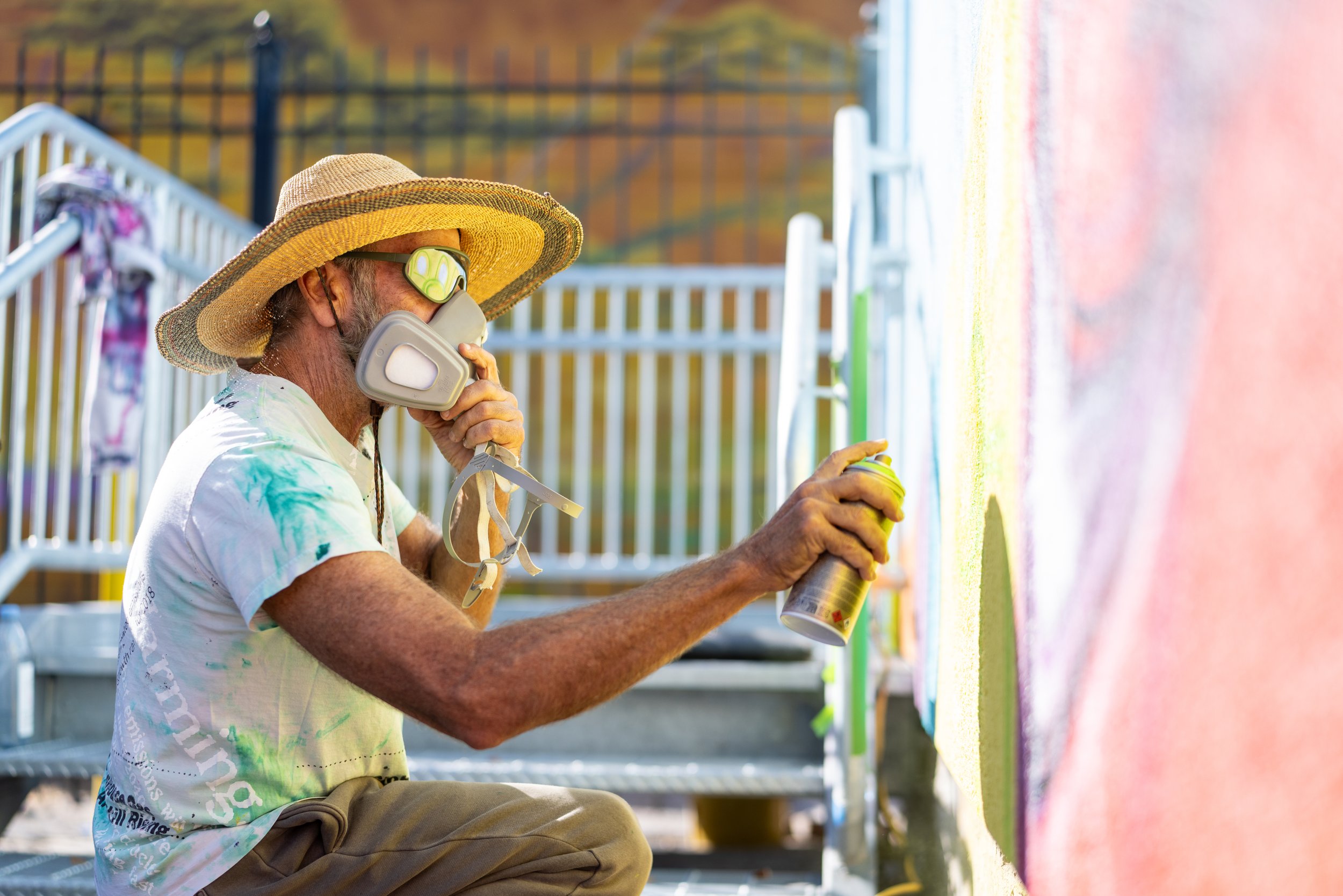
He traces it back to his childhood in the 1960s, when color television first flickered into American living rooms. “We got our first color TV when I was about seven,” he says. “I was mesmerized — the cartoons, the colors. When I moved to New York as a teenager to be an artist, I chose “The Flintstones” and “The Jetsons” because everyone knew them. They were dear to me, but they also connected people. I wanted to connect, not confuse.”
By the early 1980s, Scharf’s graffiti-style street works appeared alongside Haring’s radiant babies and Basquiat’s neo-expressionist scrawls. Together they transformed downtown Manhattan’s derelict walls into a living, breathing gallery.
But Scharf’s philosophy was always different. “Some artists want to be esoteric,” he explains. “I want mystery, but I also want to connect. I don’t want to be inaccessible. I want people — kids, families, whoever — to look at my work and smile, even if they don’t know why.”
Over time, those early pop references evolved into his own mythology of invented characters — expressive, teeming faces born from what he calls the "Time splat”. “It’s when the past and the future collide,” he says. “That collision creates chaos and chaos creates creativity — like the beginning of the universe. That’s where my characters live.”
Scharf’s mural in St. Louis, now towering over the eastern end of Midtown’s Grand Center district, is a continuation of that universal vision. It’s his second piece here, following a 2022 mural that immediately became an Instagram magnet and a symbol of renewal for the area.
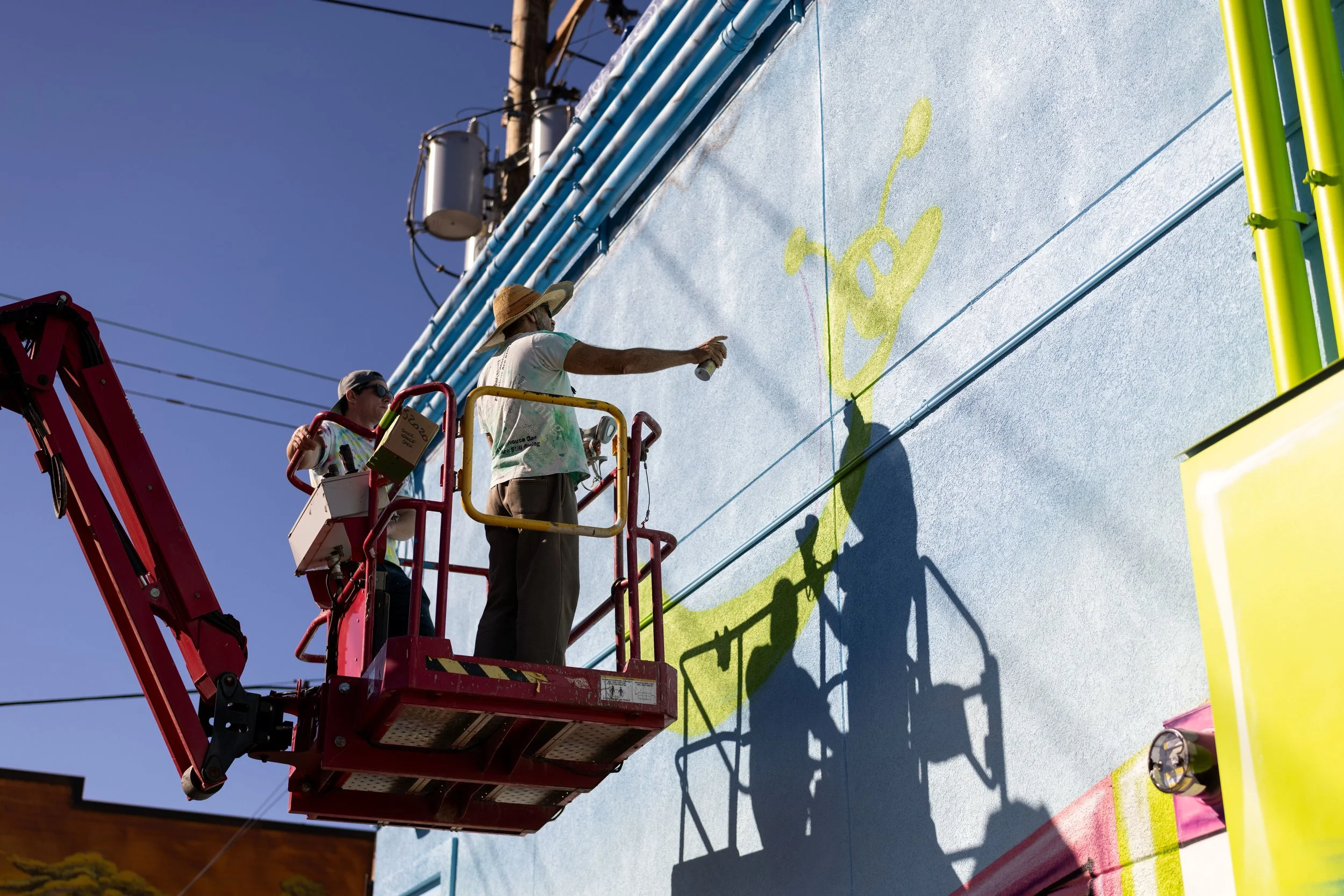
“The first one, across the street, is called ‘Kranzbergville,’” he says. “So, this new one — ‘Kranzbergville for EVA’ — it goes on forever.”
He grins as he says it, standing beneath a sunbaked wall filled with galaxies, bubbles and a swirl of faces that seem both extraterrestrial and oddly familiar. Like most of his murals, it’s unsigned. “My work doesn’t need a signature,” he says. “The characters are the signature.”
The mural is part of The Walls Off Washington, a dynamic multi-block initiative spearheaded by the Kranzberg Arts Foundation and led by curator Gina Grafos. Over the past five years, the project has brought more than 34 murals — by artists ranging from local legends like Kababi Bayoc to international stars like Nina Chanel Abney and Katherine Bernhardt — to the facades of warehouses and alleys once overlooked.
For Scharf, the appeal was immediate.
“I really like what they’re doing here,” he says. “I like the people in St. Louis. I feel like I can uplift things here. Everywhere I go, I see boring walls. It doesn’t need to be that way. So, if I can make things look better, why not?”
To understand just how transformative these walls have become, you only have to walk them with Gina Grafos, the Kranzberg Arts Foundation’s Director of Visual and Literary Arts.
On a bright morning, she walked through a maze of murals, installations and pop-up exhibits that together form one of the most immersive outdoor art experiences in the Midwest. The area, once defined by parking lots and aging brick buildings, now hums with color and life.
“The Walls Off Washington is really the vision of Mary Ann Srenko and the Kranzberg family,” Grafos explains. “It’s about public art — art that instigates curiosity, that makes people who might not feel comfortable walking into a gallery or museum feel welcome. We have works from all over the world, but also a deep commitment to St. Louis artists who have been painting our brick facades for decades.”
That balance — global and local, permanent and evolving — defines the project’s ethos. International names attract visitors, but it’s the local artists who give it soul.
Grafos rattles off a roll call that reads like a contemporary art honor list: Derrick Adams, Nina Chanel Abney, Carlos Rolon, Shinique Smith, Lady Pink and homegrown stars Kababi Bayoc, Rox Ciles, Brooklyn, Dionna Moore and Maxi Glamour.
When she reaches the mural by Bayoc, she pauses. “Kababi’s “Change Is Gonna Come” is one of my favorites,” she says. “It honors the neighborhood and faces north — toward the community that sees it every day. That’s intentional. We wanted to make sure the people who live here feel seen and inspired.”
Grafos and her team coordinate everything — from prepping walls and surfaces to securing materials and permissions. They also think deeply about placement and meaning. “When we pick a wall,” she says, “we’re not just thinking about paint. We’re thinking about sightlines, sunlight, how neighbors will experience it. It’s civic artmaking at its best.”
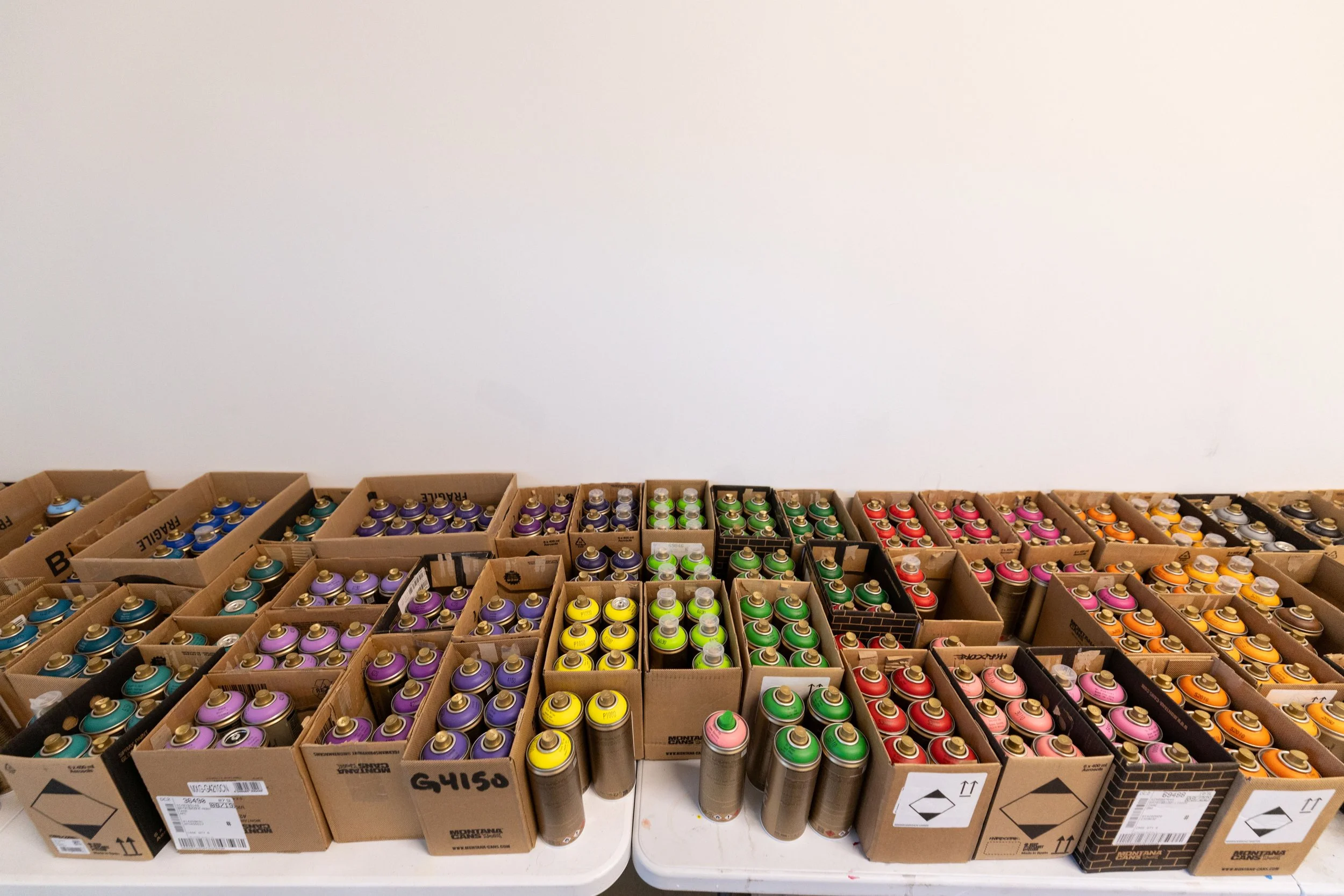
It’s impossible to talk about public art in St. Louis without talking about Ken and Nancy Kranzberg, whose philanthropic leadership has redefined the city’s cultural landscape over the past two decades.
“The Kranzbergs are the backbone of what’s happening here,” Grafos says. “They’re not just funding art — they’re creating ecosystems for artists to thrive. They’ve given us the freedom to think big, to bring in people like Kenny Scharf, to imagine St. Louis as a global arts destination.”
For the Kranzbergs, art isn’t just an amenity; it’s civic infrastructure. Their philosophy is simple yet radical: If you invest in artists, you invest in the soul of a city.
That civic vision also found support from Matt Mercer, the sales director and artists liaison at Lococo Fine Art Publisher. Lococo has collaborated with Scharf for years, producing limited-edition prints and multiples that bring his exuberant world to collectors worldwide.
“I was a fan of Kenny’s long before I ever met him,” Mercer recalls. “I studied studio art and back then, the artists you looked up to were Keith Haring, Basquiat and Kenny Scharf. They lived together in the 80s, under the umbrella of Warhol. They were rewriting what art could be.”
When Mercer moved to St. Louis and joined Lococo, he saw a chance to connect his hometown with that same creative lineage. “Robert Lococo had already done a benefit print with Kenny,” Mercer says. “I told him, ‘I’d love to meet him.’ We flew to LA, stayed at the Chateau Marmont, took Kenny to lunch and the rest is history. We’ve probably published 15 or 20 editions together since then. The friendship is the best part.”
That relationship made Scharf’s arrival in St. Louis even more meaningful. “Having him here is a real honor,” Mercer says. “It’s one thing to publish his work, but it’s another to watch him spray paint a whole wall. What he’s doing here — it’s monumental.”
For decades, St. Louis has wrestled with its self-image: a historic city with world-class institutions but a lingering reputation as a “flyover” place between the coasts. Projects like The Walls Off Washington challenge that narrative.
“People think we’re a flyover state,” Mercer says. “But once you experience it — like Crystal Bridges in Arkansas — you realize how magnetic it is. Midtown’s growing. The soccer stadium’s drawing crowds. The more we fill these walls with blue-chip artists, the more people notice. It’s happening.”
Grafos agrees. “We joke that The Walls Off Washington are St. Louis’ best-kept secret,” she said. “But that’s changing fast. During COVID, artists could safely work outside, masked and keep creating. That’s when we gained momentum. Now we have schools bringing field trips, assisted-living groups doing tours, people exploring with our app or map. It’s becoming a destination.”
Events like Music at the Intersection amplify the momentum, drawing thousands of visitors who experience the murals as a living backdrop to St. Louis’ music and culture.
“Every event — every time someone posts a selfie in front of a mural — it builds the narrative,” Grafos says. “It tells people this is a place worth visiting, worth celebrating.”
Inside The Walls Off Washington complex, art extends beyond the outdoor murals. Sophie's Artist Lounge doubles as a gallery space, featuring exhibitions like “I Still Love Her”, curated by Chris Blackman in honor of 50 years of women in Hip Hop. There’s also “The Art Yard”, a flexible event space that hosts performances, markets and installations.
Each component feeds into the larger mission: To bring art to the people.
The Kranzberg Foundation has seven galleries including Hi-Lo Gallery, The Grandel, Dark Room, Sophie's and the new Kranzberg Arts Foundation Gallery at the St. Louis County Library. “Every one of them creates opportunities for artists — and access for audiences,” Grafos says. “That’s how you change a city.”
Outside, she pointed out murals honoring St. Louis icons like Tina Turner, painted by William Burton Jr., and by one Dormir in response to last spring’s tornadoes and a stenciled Josephine Baker series by C215 that celebrates the city’s role in global Black artistry. Nearby, “Lift As You Climb” by Derrick Adams offers a visual metaphor for the community’s upward trajectory.
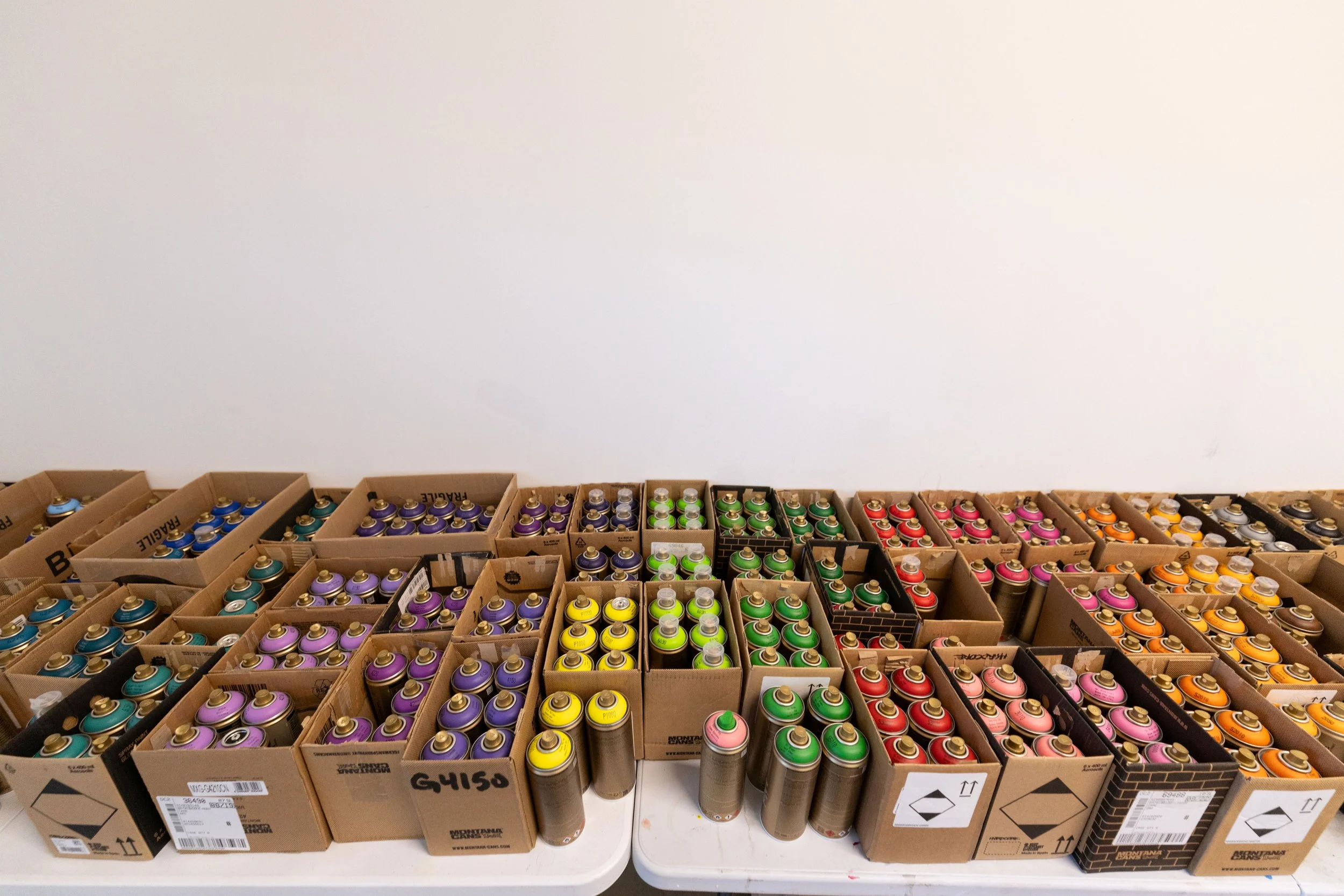
Scharf’s mural fits right into that constellation — playful, colorful but profoundly human. Even as he jokes about outer space and aliens, his art is grounded in community.
In St. Louis, he saw a reflection of what first drew him to the streets of New York: untapped potential, creative risk and people eager to participate. “When neighborhoods come alive through art, everyone benefits,” he says. “Look at Wynwood in Miami. It started because artists made it beautiful. Art brings people in. It makes them care.”
Yet he’s also mindful of balance. “When places get commercially successful, the question becomes: ‘Are you helping the artists or are the artists helping you?’” he says. “Ideally, it’s both. Here, it’s pure. It’s about making the city brighter.”
During our conversation, Scharf hints at future collaborations — possibly with Katherine Bernhardt, the celebrated St. Louis painter known for her vibrant, pop-infused canvases. “I have big plans,” he says. “Katherine and I relate. She likes characters, I like characters. She’s a strong figure here. If this next big project happens, I want to do it with her.”
Such a collaboration would be a full-circle moment for St. Louis, linking the city’s own global art star with one of the original icons of pop-street art. It’s also a testament to what the Kranzbergs and their foundation have built: a place where major artists not only visit but create, collaborate and invest their energy in the community.
Standing at the corner of Washington Avenue and Josephine Baker Boulevard, it’s hard not to feel the shift. What was once a quiet stretch of industrial blocks now buzzes with café chatter, camera clicks and bursts of color. A new identity is forming here — one that merges art, architecture and public life into something uniquely St. Louis.
And in true Kenny Scharf fashion, there’s humor amid the cosmic grandeur. When I complimented his sun-bleached bucket hat — a swirled pattern that reminded me of Van Gogh — he laughed. “It’s from a guy named Mali at my farmers’ market in LA,” he says. “I don’t wear sunscreen. I just wear hats.”
Perhaps what’s most striking about “Kranzbergville For EVA” isn’t its scale or pedigree but its permanence. In a city that sometimes struggles to hold onto momentum, the mural stands as proof that transformation doesn’t always come from billion-dollar projects. Sometimes it’s a wall, a can of spray paint and a belief that color can change everything.
As Grafos put it, “Art can change everything — for an individual, for a city. We’re bringing art to the people and that changes the way they see themselves.”
Scharf’s latest cosmic eruption is both a celebration and an invitation — to wander, to look up, to see the world a little brighter.
“Kranzbergville Forever,” he calls it. A mural for EVA — and a moment that reminds us that St. Louis, too, can shimmer like a supernova.