
Edward Boccia's Long-Awaited Renaissance
by Craig Kaminer
Some artists achieve fame in their lifetime. Others must wait for history to catch up.
For Edward Boccia, that moment has arrived.
This fall, St. Louis collectors and art lovers will have an extraordinary opportunity to rediscover one of the city's most influential — and most underappreciated — artists when Philip Slein Gallery presents a major exhibition of Boccia's paintings. Being published in conjunction with the exhibition is “Edward E. Boccia: Painter of Nightmares and Dreams,” the first comprehensive monograph devoted to the artist, written by art historian Rosa J.H. Berland. Together, the exhibition and the book represent far more than a retrospective. They are a long-overdue reassessment of an artist whose imagination, technical mastery and influence on generations of painters place him among the most significant figures in St. Louis' cultural history.
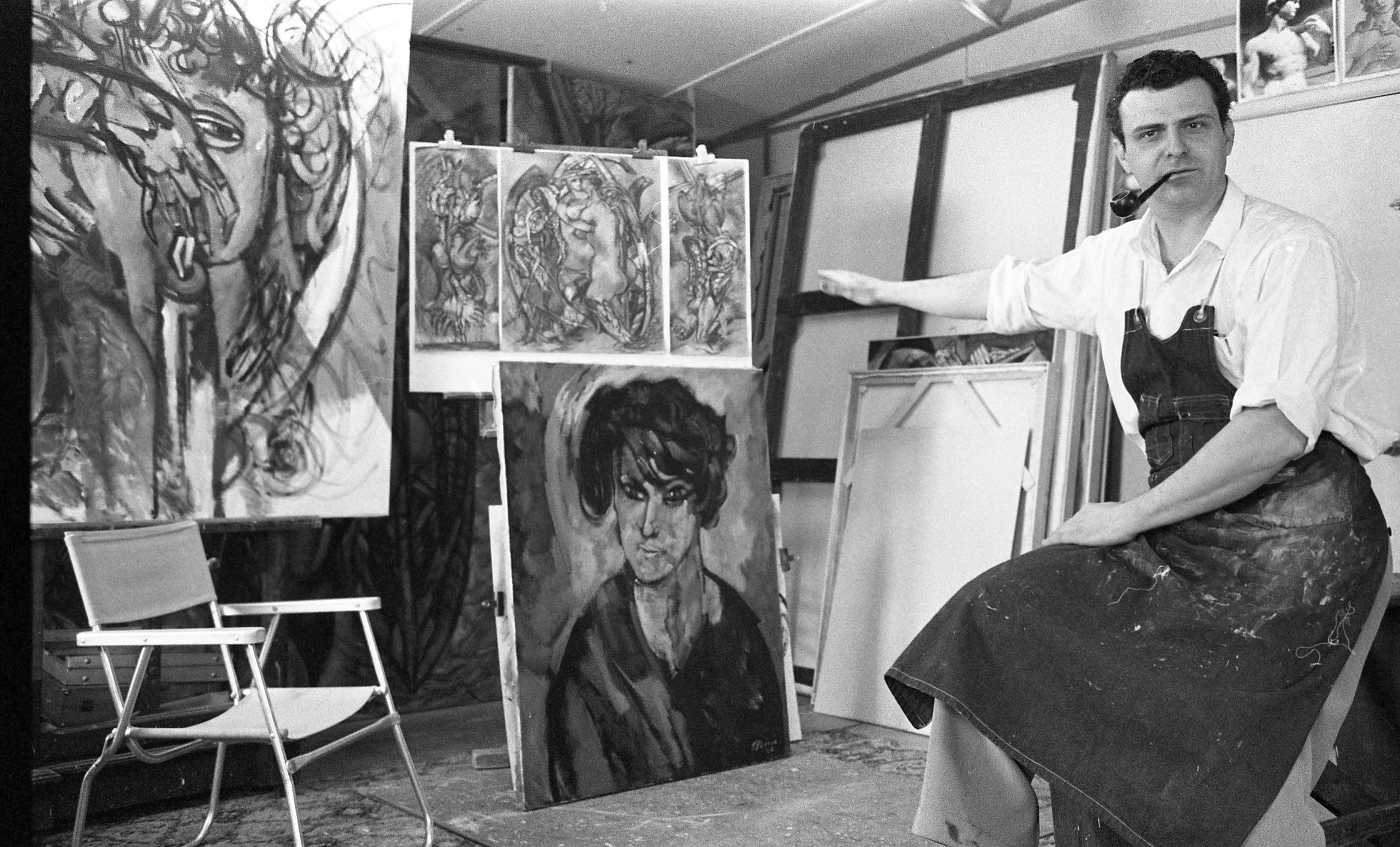
Edward E. Boccia in his St. Louis studio 1960, Courtesy of The Edward E. Boccia Artist Trust, St. Louis
Born in Newark, New Jersey, in 1921 to Italian immigrant parents, Boccia showed remarkable artistic talent almost immediately. As a teenager he was already painting commissioned murals before studying at Pratt Institute, the Art Students League of New York and Columbia University. Following service in the U.S. Army's legendary Ghost Army during World War II, he embarked on a career that would eventually bring him to St. Louis.

Edward E Boccia’s Painting Demonstration with Strozzi, St. Louis Post Dispatch 1963
When Washington University recruited Boccia in 1951, it did so on the heels of celebrated artists including Max Beckmann, Philip Guston and Stephen Greene. "That gives you a real sense of how highly thought of he already was," Berland says. "He followed these art stars to Washington University because of both his teaching ability and his artistic production."
For more than three decades, Boccia became one of the university's most influential professors, mentoring generations of artists while producing an extraordinary body of work that blended Renaissance craftsmanship, Expressionism, mythology, spirituality, literature and autobiography into a visual language unlike any other.
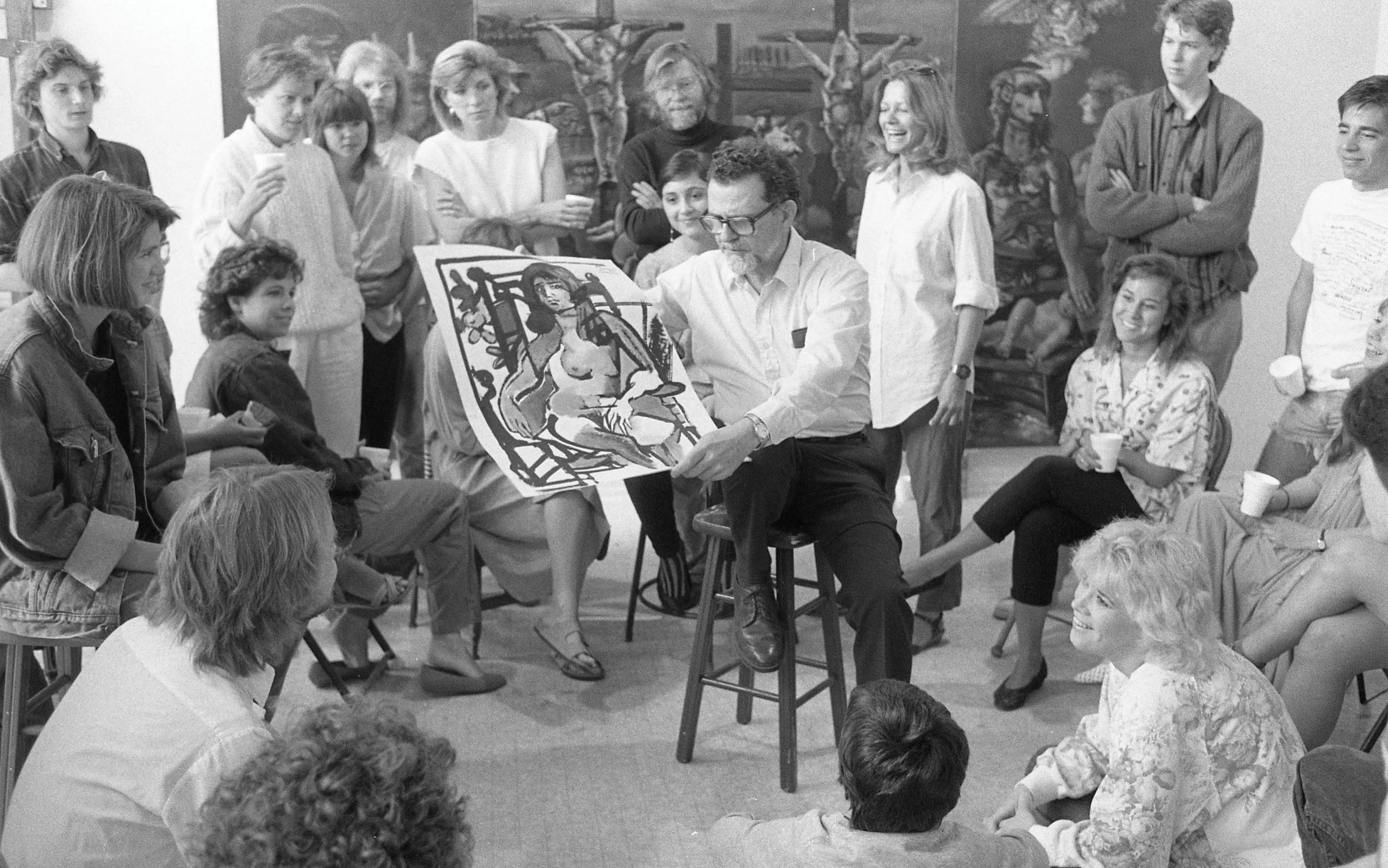
Edward E. Boccia with his students, School of Fine Arts, Washington University in St. Louis
"There really is no American artist like him," Berland says. "He combined Expressionism, Renaissance painting, regional modernism and deeply personal storytelling into something completely unique."
His paintings reward patience. Monumental figures drift through dreamlike landscapes filled with symbolism drawn from religion, philosophy, classical mythology and the artist's own life. Every canvas invites viewers to linger, discovering new relationships and meanings with each encounter.
Berland believes Boccia's originality stemmed from an unusual combination of influences. While many associate him with Max Beckmann, his artistic vocabulary was equally shaped by growing up in New York during one of the most dynamic periods in modern art.
"He wasn't simply influenced by Beckmann," she explains. "He was formed by seeing Picasso, Surrealism, Abstract Expressionism and the great European exhibitions happening in New York. Then he arrived in St. Louis, where Morton May's extraordinary collection allowed him to study masterworks up close. That's where his mature artistic voice truly emerged."
May, one of America's foremost collectors of Expressionist art, became Boccia's principal patron, purchasing works annually for decades. Their friendship proved transformative, giving the young painter unprecedented access to one of the country's finest private collections while helping establish his reputation among collectors.
Yet despite considerable success during his lifetime — including international exhibitions, major museum acquisitions and being knighted by the Italian government — Boccia gradually faded from broader public attention following his death in 2012.

Edward E Boccia’s Painting Demonstration with Braque, St. Louis Post Dispatch 1963
Berland has spent nearly a decade changing that.
What began as a catalog essay for a Saint. Louis University Museum of Art retrospective evolved into years of research involving journals, correspondence, sketches, poetry and personal archives preserved by the Boccia family.
"I had never encountered an archive this rich," she recalls. "The diaries, letters, sketches and notebooks revealed not only an extraordinary artist, but an extraordinary thinker."
The resulting book positions Boccia within the broader story of American art while challenging the long-held assumption that Abstract Expressionism alone defined postwar American creativity.
"The history of American art is often told as the story of abstraction," Berland says. "But Boccia reminds us there was another equally compelling story — one rooted in figurative painting, Renaissance traditions and profound human questions."

Edward E Boccia working in his Cutchogue, New York studio, 1998
That perspective feels especially relevant today. As museums and collectors increasingly reexamine overlooked artists, Boccia's work has begun attracting renewed national attention. While recent exhibitions in New York introduced his paintings to new audiences, the Philip Slein Gallery exhibition here in St. Louis marks the first major presentation to coincide with Berland's landmark publication.
The exhibition will feature approximately 30 paintings spanning five decades, including several of Boccia's celebrated multi-panel works inspired by Renaissance altarpieces.
"Those paintings are among his greatest achievements," Berland says. "They combine the scale and power of Renaissance art with deeply modern subjects. They're incredibly moving."
Perhaps Boccia's greatest legacy extends beyond his paintings. His students consistently describe him as a demanding yet generous mentor whose insistence on mastering drawing and composition shaped not only their artwork but also their own teaching careers.
"He dedicated his life to making young artists better," Berland says. "His influence reaches far beyond his own paintings because so many of his students carried those lessons into classrooms across America."
For St. Louis, the exhibition serves as a reminder of the city's remarkable artistic legacy — a legacy built not only by gifted artists, but also by visionary patrons, museums and universities that created one of America's most vibrant mid-century cultural communities.
"People think of New York as the center of the art world," Berland says. "But artists like Edward Boccia became who they were because of St. Louis. Its collectors, its institutions and its commitment to art allowed him to flourish."
The convergence of Philip Slein Gallery's exhibition and Berland's beautifully illustrated book offers collectors and art lovers a rare opportunity to rediscover a painter whose work has never been more relevant.
Sometimes history doesn't change. It simply catches up.
Edward E. Boccia: An American Modernist
October 23, 2026–April 23, 2027
Philip Slein Gallery presents Edward E. Boccia: An American Modernist, on view October 23, 2026–April 23, 2027. Featuring important paintings from the artist's estate, the exhibition surveys five decades of Boccia's work, bringing together landmark paintings from throughout his career. The exhibition coincides with the publication of Edward E. Boccia: Painter of Nightmares and Dreams (Hirmer Publishers), the first major scholarly monograph devoted to the artist.
Philip Slein Gallery, 4735 McPherson Ave., St. Louis, MO 63108, (314) 361-2617
Gallery Hours: Thursday–Saturday, 11:00 a.m.–4:00 p.m. (or by appointment)
Reception 5-8 pm Friday October 23, 2026
Rosa JH Berland Edward E. Boccia: Painter of Nightmares and Dreams, Hirmer Verlag Munich, 164 pages, 50 color illustrations, 290 × 240 mm, hardcover. ISBN 978-3-7774-4463-5.

Book Cover Rosa Berland Edward E. Boccia Painter of Nightmares and Dreams Hirmer Verlag Munich 2026
30 works for Slein show including multi panel works such as the late 2006 diptych Young Adam and Eve, Oil on canvas, 3 ft. × 4 ft, and examples of the artist’s large scale masterwork format like the 2004 triptych David's Death, 2004, 6 ft. × 7 ft. 6 in and the polyptych Waiting for the Coming of a Stranger, 1993, 2 ft. 6 in. × 9 ft. 8 in.)
A Glimpse at the Philip Slein Gallery presents Edward E. Boccia: An American Modernist Exhibit
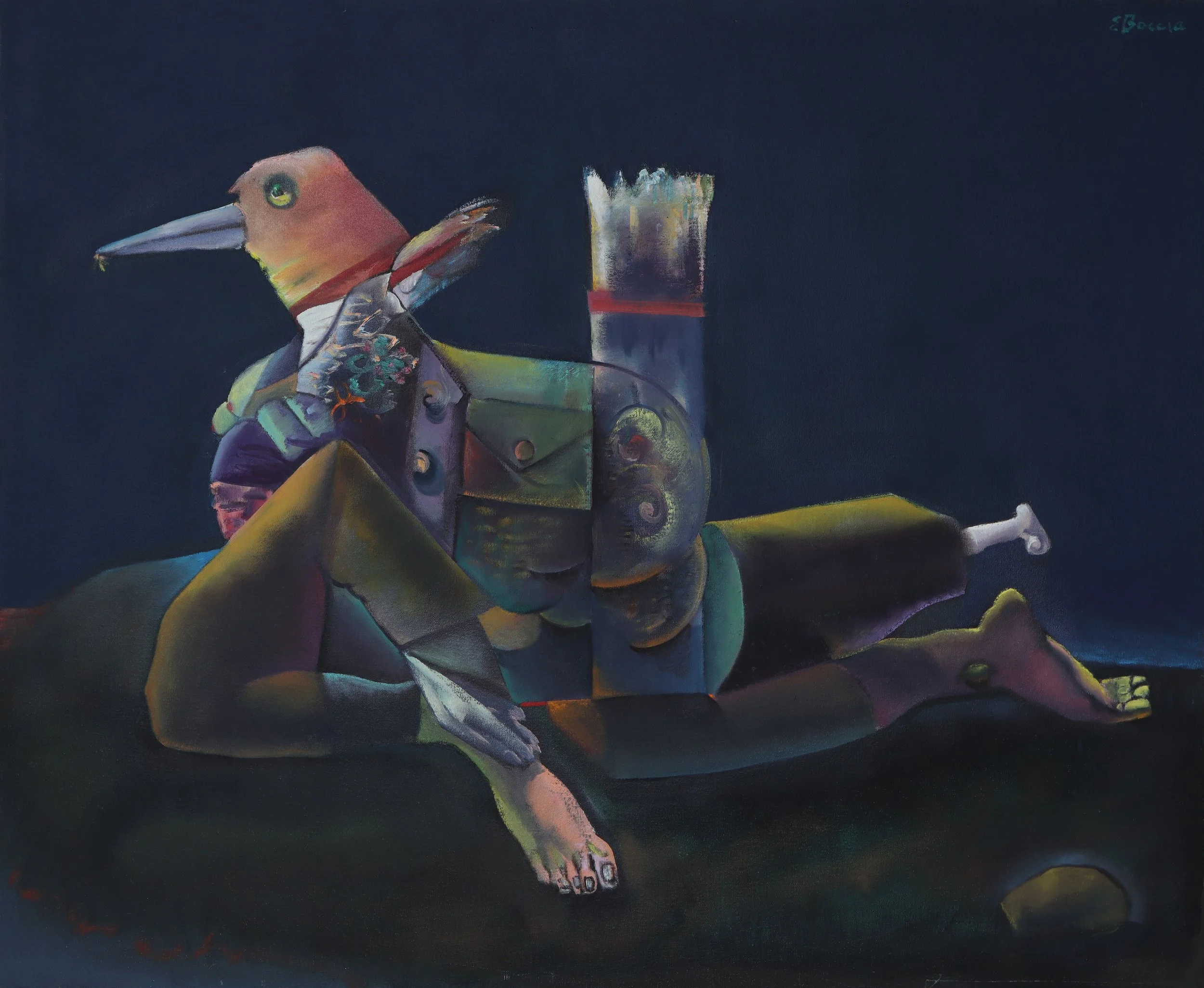
Edward E. Boccia, Bird of Paradise, 1982, oil on canvas, 38 x 46 in

Edward E. Boccia, Ephraim Morning, 1984, oil on canvas, 91 1 2 × 56 inches, Courtesy of Philip Slein Gallery, St. Louis

Edward E. Boccia, Frans Hals, 2010, oil on canvas, 36 x 24 inches, Courtesy of Philip Slein Gallery, St. Louis
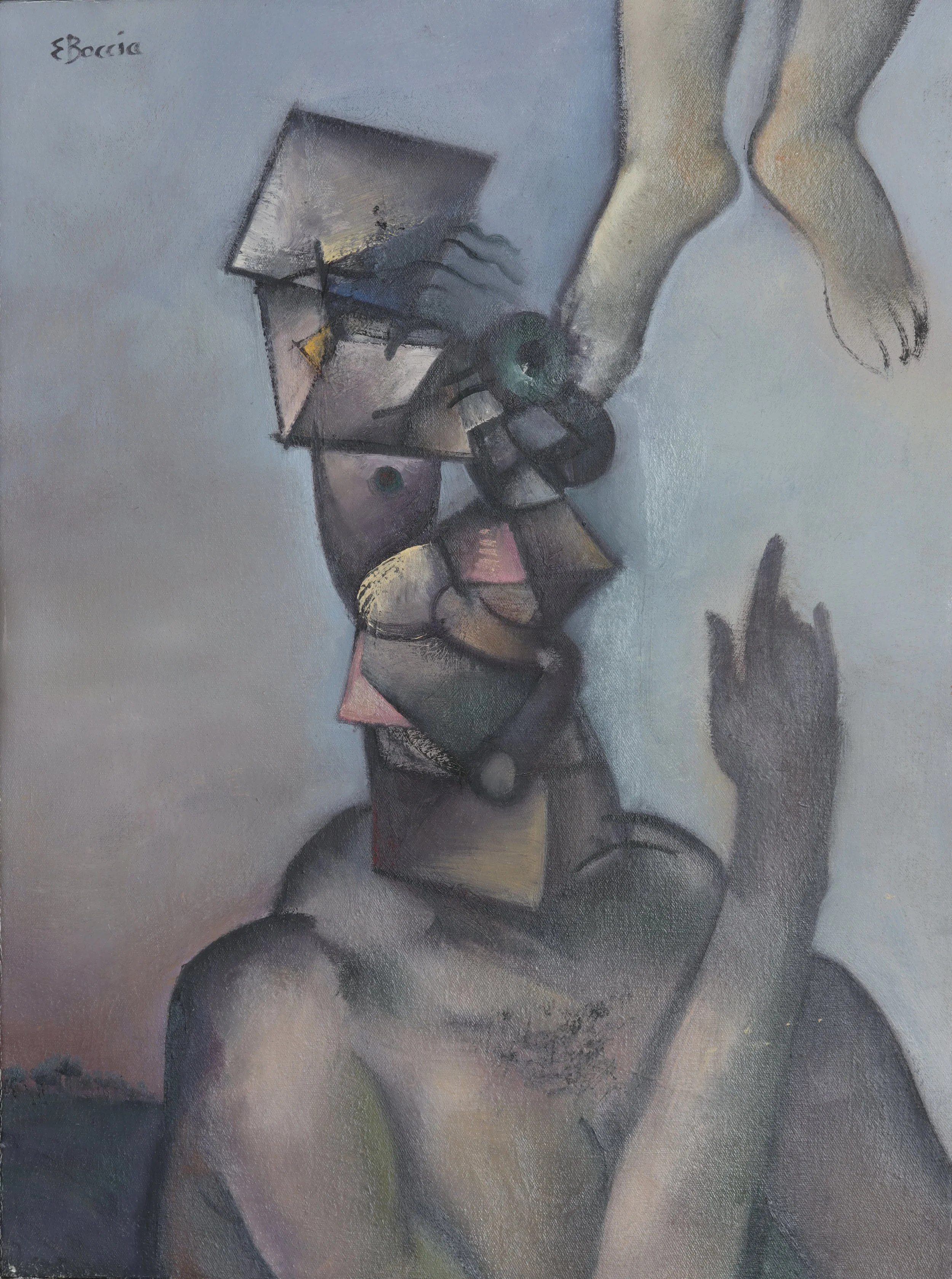
Edward E. Boccia, The Ascension of a Secular Man, 1990, oil on canvas, 24 x 18 in, Courtesy of Philip Slein Gallery, St. Louis