
Defenders of the Dispossessed
ArchCity Defenders has spent 15 years fighting for St. Louis' most vulnerable residents — and Blake Strode is making sure the mission keeps growing.
By Christy Marshall | Photos by John Lore
It started on a napkin. Somewhere around 2009, three Saint Louis University law students — Thomas Harvey, Michael-John Voss and John McAnnar — sat down at Café Ventana and sketched out an idea: a nonprofit law practice that would give poor and homeless St. Louisans the kind of legal muscle money usually buys. No fee. No catch. Just free representation for people trapped in a system that was, by almost any measure, designed to keep them there.
That napkin became ArchCity Defenders.
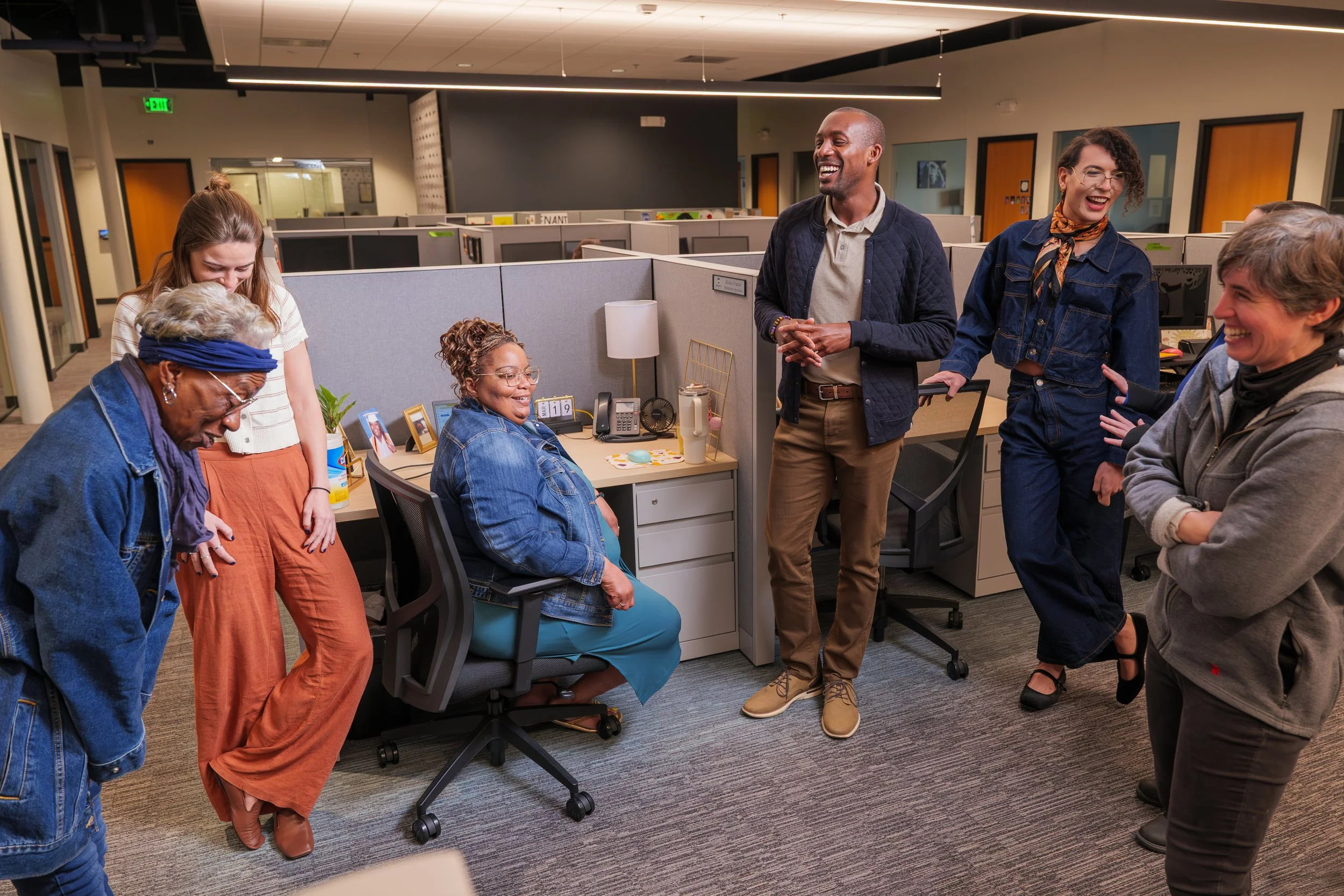
Beck Fife, Caylie Privitere, Alisha Frazier, Blake Strode, Don Hussain, Z Gorley
The three founders had seen firsthand, through internships with the public defender's office and Legal Services of Eastern Missouri, how poverty worked as a legal trap. An unhoused person gets a loitering ticket. They can't pay the fine. A warrant gets issued. Now they can't get a job or find housing. The warrant follows them everywhere, compounding misery like interest on a debt they never agreed to carry. Harvey, Voss and McAnnar decided somebody had to get into that machinery and start pulling people out.
For the first few years they worked unpaid. Then, in 2012, a homelessness prevention grant from the city of St. Louis allowed ArchCity to hire its first staff. The organization was small, scrappy and, in the broader civic conversation, largely invisible.
Then came Ferguson.
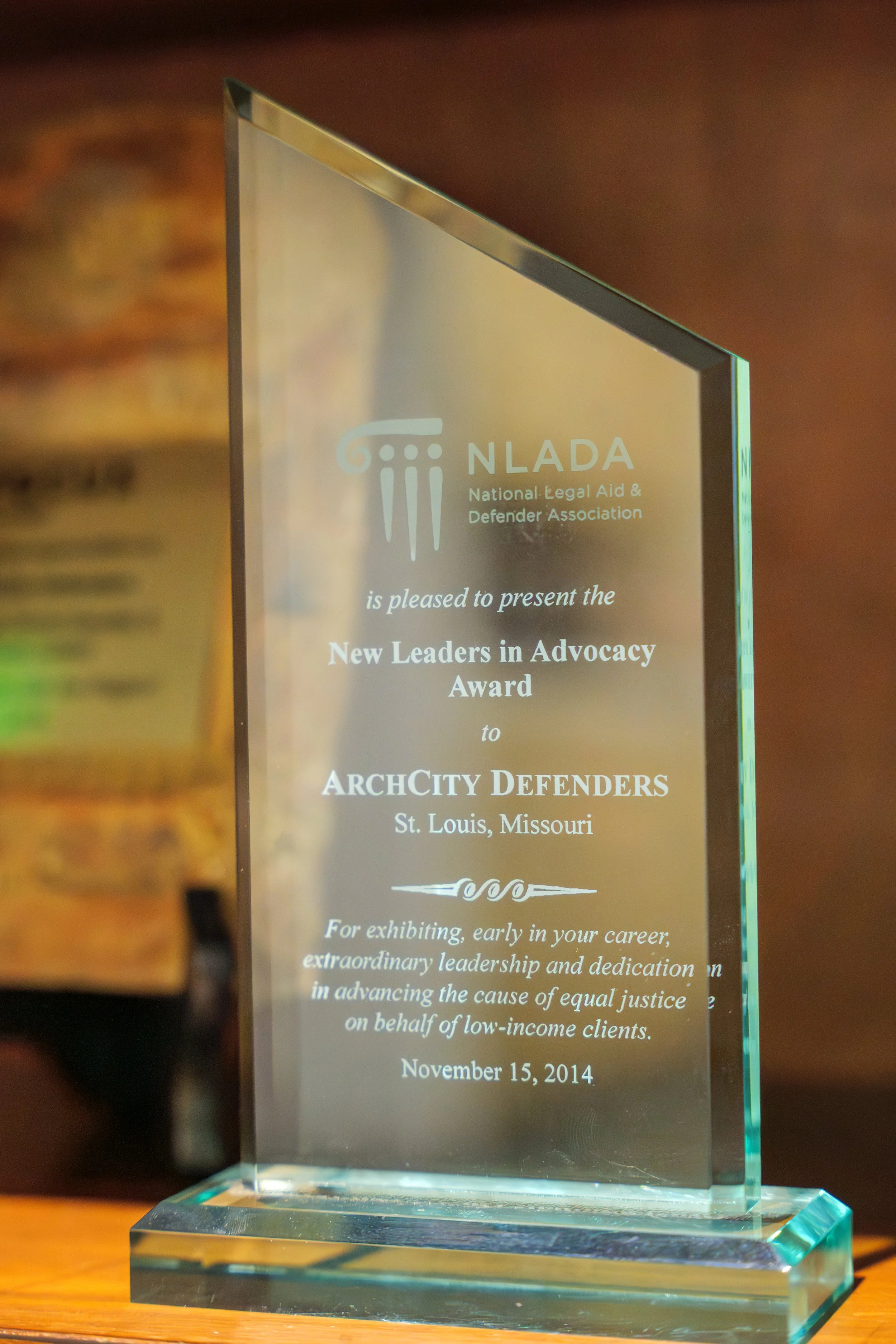
On August 9, 2014, Michael Brown was shot and killed in Ferguson. The eruption that followed was not just about one officer and one young man. It was about a system — and ArchCity Defenders had already been documenting it for years. Staff members, interns and volunteers had been doing something deceptively simple: sitting in courtrooms, watching, and writing down what they saw. Who appeared. What the judge said. What rights were or were not communicated. What the outcomes were. They called it court watching, and it produced a remarkable accumulation of data.
Shortly after Brown's killing, ArchCity released a white paper detailing what was happening in the municipal courts of North St. Louis County — in Ferguson, Jennings and dozens of municipalities like them. The picture it painted was stark: municipalities were using their courts essentially as revenue machines by stopping, ticketing and jailing mostly low-income Black residents to collect fines. The paper cited numbers and gave national journalists and policymakers a framework for understanding what the Ferguson uprising was really about.
It put ArchCity Defenders, an organization funded entirely by private donations and foundations, on the map.
Blake Strode grew up in North St. Louis County — Charlack, then Berkeley, then Bridgeton, moving a little north and west as the years passed. He graduated from Pattonville High School in 2005 and then left for about a decade.
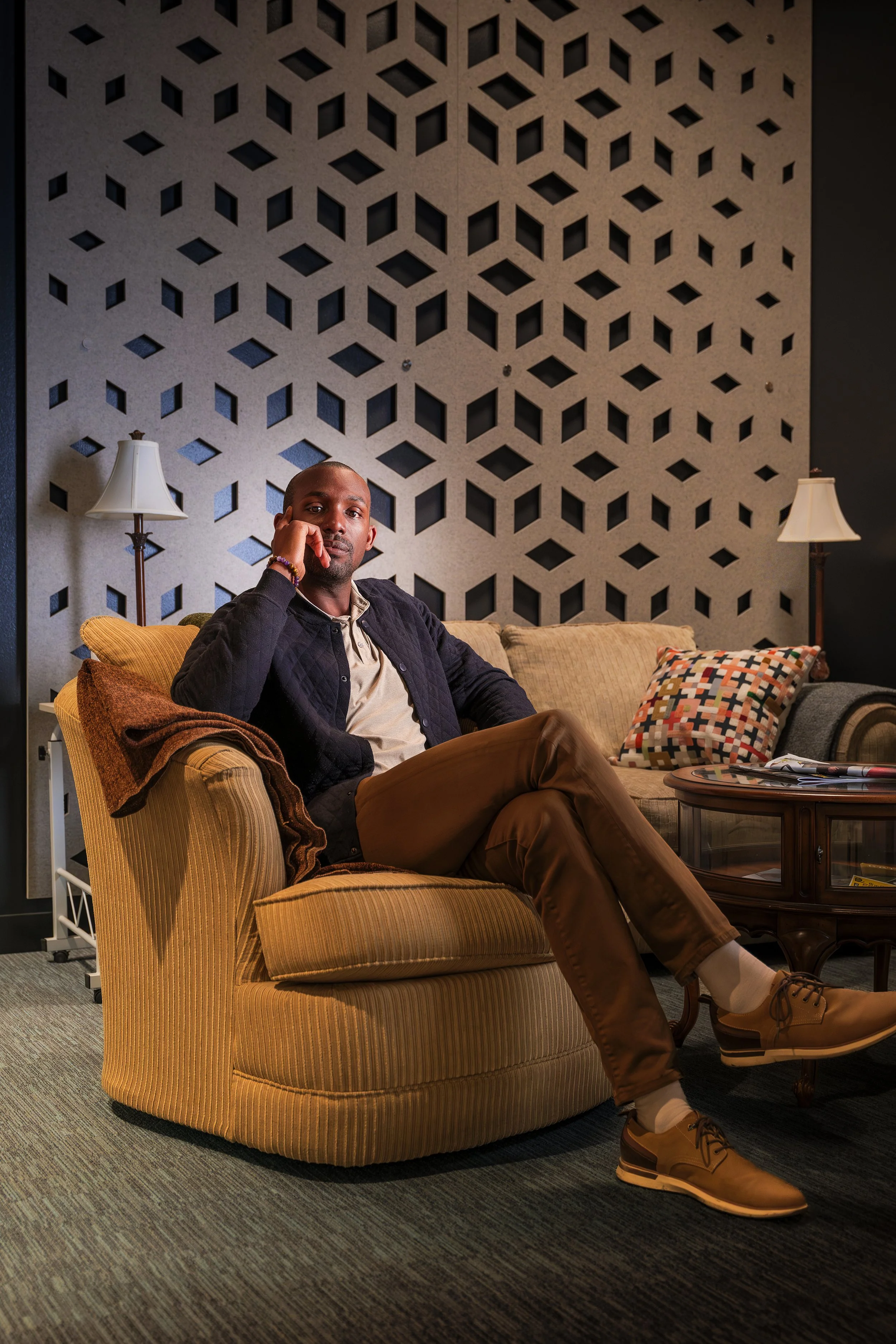
Blake Strode
He went to the University of Arkansas on a tennis scholarship. After graduating, he deferred his admission to Harvard Law School three consecutive years to travel the world playing professional tennis. He competed in U.S. Open qualifying. He lived out of a bag, bounced between buses and budget hotels and played the sport he loved across the globe.
He started Harvard Law in 2012. The experience was, he admits, disenchanting for much of it. He arrived with big ideas about social justice and found that law school wasn't especially interested. "Professors sort of tolerate your idealistic views of the world, but that's not really what they're there to teach you." By his third year he was questioning whether he'd pursue practicing law at all, and assumed that if he did civil rights work, it would have to be in New York or San Francisco or Atlanta. Not St. Louis.
Then a friend sent him a “Washington Post” article about a small nonprofit back home. It was called ArchCity Defenders.
Strode cold-called founder Thomas Harvey — a move he now acknowledges as naive given the realities of nonprofit finances. Harvey's response was essentially: We'd love to have you, but we can't pay you. What followed was a Skadden Fellowship application. Funded by the powerhouse New York-based law firm Skadden, Arps, Slate, Meagher & Flom LLP, the fellowship has, for 35-plus years, quietly bankrolled public interest legal work across the country, focusing on anti-poverty cases. Strode applied, won the fellowship and came back to St. Louis in the fall of 2015.
He's never left and now serves as executive director.
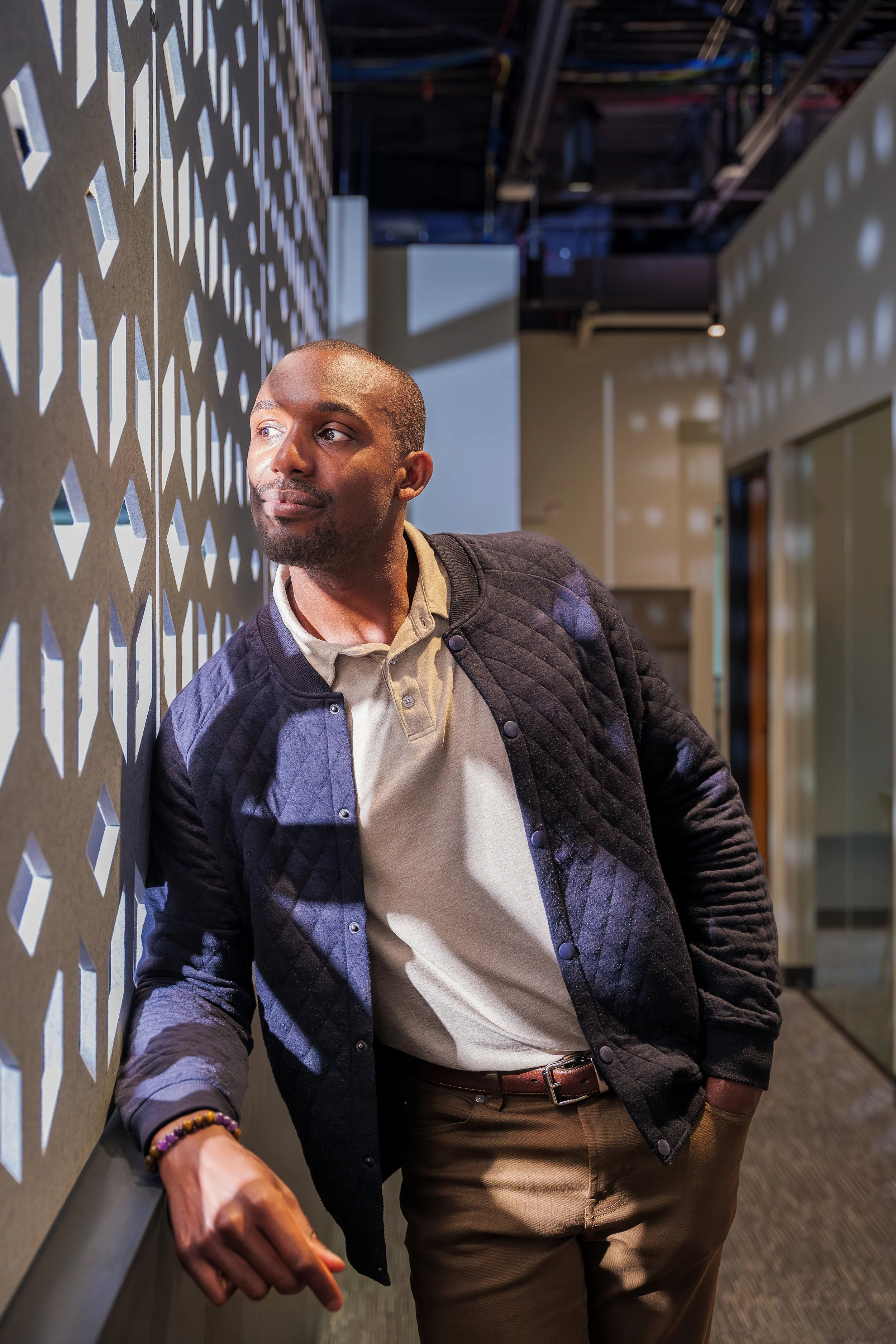
ArchCity Defenders Executive Director Blake Strode
When Strode arrived, ArchCity Defenders was building out its civil rights litigation practice, but its foundational approach was already established — a model borrowed from the Bronx Defenders, the New York nonprofit founded in the 1990s by Robin Steinberg. The concept is called holistic defense, and it starts with a simple but radical premise: poor people don't have one problem. They have overlapping problems, and you can't solve one without addressing the others.
Today, ArchCity Defenders has three legal teams — municipal defense, housing and civil rights litigation — along with a social services team, a partnerships and organizing team and a communications team. A client who walks in facing a stack of municipal warrants might, in the course of their intake, reveal that they also have an unresolved landlord dispute, a custody matter that never got finalized and a food insecurity issue they've been quietly managing for months.
"It's not unusual," Strode says, with a slight laugh, "for a client to have some engagement with all of those functions of ArchCity Defenders."
The social services team — staffed by social workers and case managers, not attorneys, conducts its own intake, asking about food security, housing stability and other pressures that a legal intake would miss. Where ArchCity Defenders can address a need in-house, it does. Where it can't, it makes what Strode calls warm handoffs to partner organizations around town.
The partnerships and organizing team goes further still. ArchCity Defenders doesn't just serve clients — it organizes them. The “We the Tenants” campaign brings together renters facing eviction, unsafe housing conditions and abusive landlord practices. These aren't passive clients receiving services; they're active members of a campaign pushing for policy change.
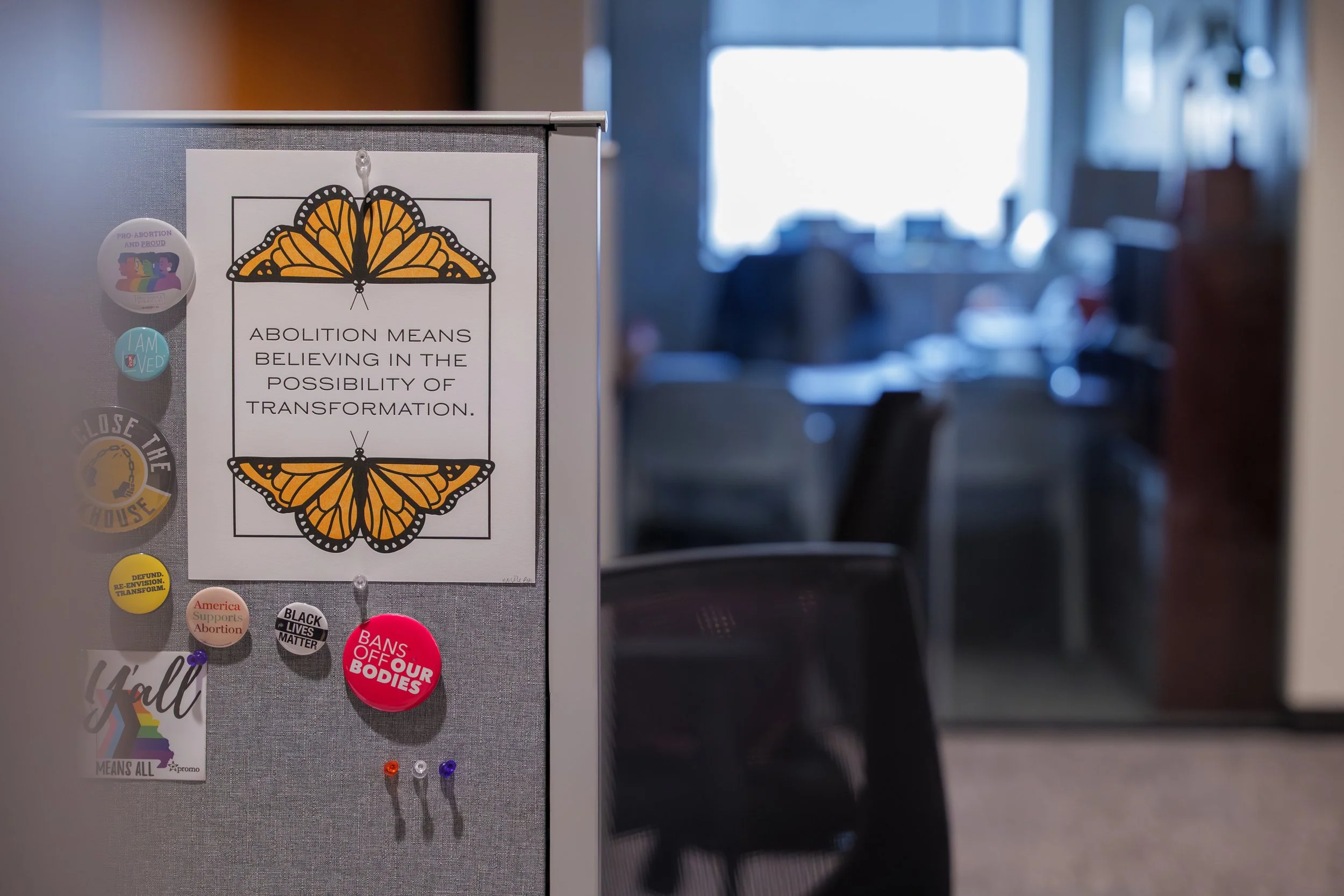
From 2014 to 2018, ArchCity filed lawsuit after lawsuit challenging what it calls the debtors' prison concept — the practice of jailing people for unpaid fines and fees. It took on municipalities, challenged abuses of power across the region and won. Those cases, built on years of court-watching data and client representation, reshaped how municipal courts in the St. Louis region were allowed to operate.
One of the organization's most concrete policy victories has been Right to Counsel in housing court. The numbers driving that campaign are startling: in eviction proceedings in St. Louis, over 90 percent of landlords have legal representation, while over 90 percent of tenants do not. ArchCity successfully advocated for a city ordinance guaranteeing tenants facing eviction the right to legal representation — a policy it is still working to see fully implemented.
Strode is characteristically direct about why this matters. "That kind of imbalance leads to abuse," he says. "It's that simple."
He is also clear-eyed about the broader argument underlying everything ArchCity does. The organization is not interested in incremental tweaks to a system it considers fundamentally broken. It is not, as Strode puts it, trying to police its way or jail its way out of the problems facing North St. Louis. "It is about stable communities. It's not a coincidence that places that are really wealthy and stable have lower levels of violence. We just have to make rational choices about where we direct our resources."
ArchCity's newest chapter has a physical address: 5939 Goodfellow Blvd., the Northside Movement Center. The building was, for decades, the family life center of New Northside Baptist Church, and before that a neighborhood grocery store. ArchCity purchased it in January 2024, worked with Trivers Architects on a full gut renovation and moved in at the start of 2026.
The center is a co-location hub. ArchCity shares it with Action St. Louis, its closest organizing partner. The vision — which Strode and colleagues began dreaming up in late 2021 — was always about more than office space. North St. Louis has long been overrepresented among ArchCity's client base. Putting the organization's services, advocacy and organizing work in that community, rather than downtown, is itself a statement.

The grand opening drew somewhere between 350 and 400 people. There was a resource fair, a partner showcase and neighbors seeing for the first time what was being built in their community. Strode, who is not given to hyperbole, calls the possibilities "limitless."
Ask Strode about his priorities and concerns and he does not reach for platitudes. He worries about what he calls a resource drift — as political winds shift, the funding that sustains equity-focused grassroots organizations is quietly drying up. Organizations born out of the post-Ferguson moment, like ArchCity, Action St. Louis and Freedom Community Center, are facing funding cliffs. "That's dangerous for us as a region," he says.
He is equally concerned about what he sees as a retreat into punitive thinking — more police, more jails, more prosecution — at exactly the moment when data and experience argue for the opposite. "We already have incredibly high levels of all of those things from a global standpoint," he says. "Really unprecedented levels of human caging in this country. We don't need more of that. We need more care and support."
His immediate goals center on housing: more funding for affordable units, more tenant protections, better homeless services and relief for residents still displaced by last year's tornado. He also believes this is the moment to possibly tap the as monies remaining in the St. Louis Rams settlement fund to investin the communities that have been hardest hit.
It is, in other words, the same fight it has always been — just bigger, better funded and now conducted from a building on Goodfellow that was once a church that fed the neighborhood.
Now, in a different way, it still does.
GET INVOLVED
ArchCity Defenders welcomes volunteers for court watching, events and community advocacy campaigns. The organization is funded entirely through private donations. Learn more at archcitydefenders.org